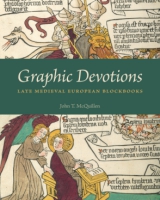



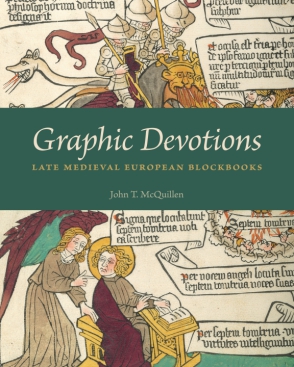
Graphic Devotions
Late Medieval European Blockbooks
John T. McQuillen, with a foreword by Colin B. Bailey, and with contributions by Peter Parshall, and Reba Fishman Snyder
Graphic Devotions
Late Medieval European Blockbooks
John T. McQuillen, with a foreword by Colin B. Bailey, and with contributions by Peter Parshall, and Reba Fishman Snyder
“This important volume restores blockbooks to their rightful place as a subject of serious scholarly inquiry alongside manuscripts and early printed books. Every scholar interested in the history of the book, whether in the fifteenth or sixteenth centuriy or beyond, and every library, especially reference and research libraries, will want a copy of McQuillen’s comprehensive catalogue, which further includes four chapters about the history of blockbooks, which were made alongside and sometimes after books produced with moveable type.”
- Description
- Reviews
- Bio
- Subjects
This volume draws on the author’s recent discoveries in production and copy history to provide both a synthetic study of the medium and the first comprehensive descriptive census of extant blockbooks in US collections. Across four chapters, it examines how blockbooks were produced, circulated, and read both by early readers and by later collectors and demonstrates that they cannot be understood simply as reproductions of manuscripts or precursors to typographic books. Grounded in extensive firsthand examination of surviving copies, it integrates bibliographical, codicological, and material analyses, addressing printing techniques, bifolia production, relationships to manuscript and print traditions, and the physical materials of manufacture, including papers, inks, and pigments.
At the heart of the book is its descriptive census, which records every known blockbook or fragment held in US public and private collections, noting physical characteristics, provenance, and dispersed leaves to aid in reconstructing original copies. By placing material evidence at the center of inquiry, the book establishes a new foundation for blockbook studies. It will be indispensable for scholars and students of book history, bibliography, medieval studies, art history, and the history of printing.
“This important volume restores blockbooks to their rightful place as a subject of serious scholarly inquiry alongside manuscripts and early printed books. Every scholar interested in the history of the book, whether in the fifteenth or sixteenth centuriy or beyond, and every library, especially reference and research libraries, will want a copy of McQuillen’s comprehensive catalogue, which further includes four chapters about the history of blockbooks, which were made alongside and sometimes after books produced with moveable type.”
“Colorfully animated, blockbooks explained the universal themes of life, death, and the Apocalypse through structured visions of fantastical figures with explanatory captions. We are still discovering the ways these woodcuts and their hand-carved texts were produced. This pithy, close look at the material evidence in surviving blockbooks in the United States will reintroduce these vibrant graphical volumes to scholars, artists (especially cartoonists), and other new audiences.”
John T. McQuillen is Associate Curator of Printed Books & Bindings at the Morgan Library & Museum. For the Morgan, he has curated or cocurated the exhibitions William Caxton and the Birth of English Printing (2015), Word and Image: Martin Luther’s Reformation (2017), Bound for Versailles: The Jayne Wrightsman Bookbindings Collection (2021–22), Holbein: Capturing Character (with the J. Paul Getty Museum, 2021–22), and Seeds of Knowledge: Early Modern Illustrated Herbals (2023–24). He was the organizing curator for the landmark Tolkien: Maker of Middle-Earth (2019), a loan exhibition from the Bodleian Library, Oxford.
Also of Interest
Mailing List
Subscribe to our mailing list and be notified about new titles, journals and catalogs.