


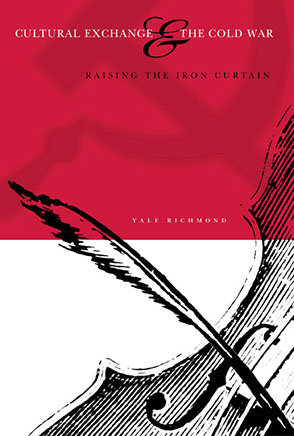
Cultural Exchange and the Cold War
Raising the Iron Curtain
Yale Richmond
“Richmond, a leader in the organization of cultural exchanges during the Cold War, has written a compelling and fact-filled book on the value of travel and face-to-face meeting between adversaries as a method of reducing tension and promoting peace. The cost-benefit analysis definitely favors exchanges (as opposed to war or an arms race) as a tool to assist in the preservation of peace and security. Good bibliography.”
- Description
- Reviews
- Bio
- Table of Contents
- Sample Chapters
- Subjects
This study is based upon interviews with Russian and American participants as well as the personal experiences of the author and others who were involved in or administered such exchanges. Cultural Exchange and the Cold War demonstrates that the best policy to pursue with countries we disagree with is not isolation but engagement.
“Richmond, a leader in the organization of cultural exchanges during the Cold War, has written a compelling and fact-filled book on the value of travel and face-to-face meeting between adversaries as a method of reducing tension and promoting peace. The cost-benefit analysis definitely favors exchanges (as opposed to war or an arms race) as a tool to assist in the preservation of peace and security. Good bibliography.”
“At a time of increasing barriers to those who would enter the U.S. as students or observers, Cultural Exchange and the Cold War demonstrates the value of openness even during the most stressful periods of the Cold War. American leaders coming from a broad political spectrum took the risk of allowing access to this country by students and leaders from our most feared competitor. From this there appears to have been an unimagined payoff.”
“Richmond’s insider’s insights add flavor to the book and make a compelling argument for the success of the US policy to encourage the ‘Westernization’ of the Soviet Union instead of direct confrontation.”
“Richmond writes eloquently, liberally using quotes of people who took part in the exchanges.
Scholarly and illuminating, Richmond’s book colorfully documents official, government Soviet-American cultural exchanges that began after Stalin died in 1953, and helped to break down barriers of fear and ignorance, at a time that many of us felt the Cold War was freezing all contact.
I love this book because it is informative, inspiring, and written with obvious relish and passion.”
“Yale Richmond records a highly significant chapter in Soviet-American relations during the final decades of Communism. He provides us with a deftly written, accurate, and thoughtful account of the cultural exchanges that were such important channels of influence and persuasion during those years. His book covers the whole spectrum—from scholars and scientific collaboration to fairs and exhibits. We should be grateful that he has undertaken this task before memories fade.”
“As a retired foreign service officer who served in the Soviet Union and maintained contacts with numerous exchange participants, Richmond is well qualified to study this topic.”
“This book makes an important contribution to a major debate that began in the West before the demise of the Soviet empire and escalated after 1989. . . . the value of this book lies in its firm focus on the Soviet Union. Richmond speaks from his experience as a former foreign service officer who, for some 30 years of his distinguished career, lived in the Soviet Union, Poland, Austria, Germany, and Laos. He is also a good historian who knows that this subject cannot be understood without putting it into the context of the long connection between Russia and the West, going back to Peter the Great, if not before.”
“Yale Richmond, a career U.S. Information Agency officer with extensive experience in East-West cultural exchanges, provides a thorough, lucid, and provocative account of the key factors leading to the end of the Cold War.”
Yale Richmond, now retired, spent more than forty years in government service and foundation work, including thirty years as a Foreign Service Officer in Germany, Laos, Poland, Austria, the Soviet Union, and Washington, D.C.
Contents
Preface
Acknowledgments
Introduction
Abbreviations and Acronyms
1. Russia and the West
2. The Moscow Youth Festival
3. The Cultural Agreement
4. Scholarly Exchanges
5. Science and Technology
6. Humanities and Social Sciences
7. Moscow Think Tanks
8. Forums Across Oceans
9. Other NGO Exchanges
10. Performing Arts
11. Moved by the Movies
12. Exhibitions—Seeing is Believing
13. Hot Books in the Cold War
14. The Pen Is Mightier . . .
15. Journalists and Diplomats
16. Fathers and Sons
17. The Search for a Normal Society
18. "Western Voices"
19. To Helsinki and Beyond
20. Mikhail Gorbachev, International Traveler
21. And Those Who Could Not Travel
22. The Polish Connection
23. The Beatles Did It
24. Obmen or Obman?
25. The Future
Afterword
Bibliography
Index
Introduction
Soviet visits to the West persuaded them to trust us more and fear us more, while Western visits there persuaded us to trust them less and fear them less.
—Jeremy J. Stone, former president, Federation of American Scientists
What caused communism to collapse and the Cold War to come to a close?
Some say it was Ronald Reagan who sullied the Soviet Union with his "evil empire" speech. Others point to Pope John Paul II and his visits to Catholic Poland, which challenged Soviet rule in Eastern Europe and ultimately the entire Soviet bloc. Still others recognize the role of the U.S. military buildup, the threat of "Star Wars," and the simple solution that we spent the Soviets into submission. Also credited are international radio broadcasts—the Voice of America, BBC, and Radio Liberty—that exposed the fabrications of the Soviet media.
There are also Western Sovietologists who maintain that the Soviet Union brought about its own demise through mismanagement at home, overextension abroad, an unwise intervention in Afghanistan, failure to cope with the Chernobyl nuclear disaster, and suppression of innovation in politics, economics, and the arts. As former U.S. ambassador to Moscow Jack Matlock has put it, "The Communist dictatorship collapsed under the weight of its own contradictions and irrationality."
Also given credit for the Soviet demise is glasnost—the end of state control over the media—and the resultant information explosion in the Soviet Union that exposed the horrors of the past and the realities of the present. Yet another notion credits the abatement of fear among the Soviet people and the emergence of a dissident movement encouraged by the Helsinki Accords on human rights that challenged the authority of the Communist Party. There is even a theory that rock and roll, a Western import, seduced Soviet youth and eroded the authority of the Party’s ideologists. And finally, many Russians tell us that glasnost and perestroika, and much that followed, were purely domestic developments that resulted from a reform movement within the Communist Party of the Soviet Union.
There is a grain of truth is some of these explanations, and more than a grain in others. But in the following pages readers will find many grains of another explanation—that the end of the Cold War and the collapse of communism were consequences of Soviet contacts and exchanges with the West, and with the United States in particular, over the thirty-five years that followed the death of Joseph Stalin in 1953. Moreover, those exchanges in culture, education, information, science, and technology were conducted by the United States openly, for the most part, under agreements concluded with the Soviet government, and at a cost that was minuscule in comparison with U.S. expenditures for defense and intelligence over the same period of time. The result was an increase in Western influence among the people in Russia who count—the intelligentsia.
As U.S. political scientist Michael Mandelbaum wrote in 1988: "Western values have been incubating for two decades. Changes took place under the surface of events during the Brezhnev period. In private conversations, in technical and specialized journals, and in more general publications couched in Aesopian language, controversy, debates, and Western themes began to appear. . . . [T]he intelligentsia of today are certainly better attuned to Western values than were their predecessors a generation ago." The reach of the West was delineated by Vasily Aksyonov, the renowned Russian writer who now divides his time between Russia, France, and the United States: "Far behind the indestructible iron curtain we had somehow managed to develop a pro-Western mentality—and what could be farther West than America?"
Official Washington, however, tended to downgrade the importance of the West’s attractions during the Cold War, focusing instead on the Soviet Union’s missiles and ground forces. Concerned mainly with Moscow’s ability to project its power abroad, Washington underestimated its ability to influence the Soviet intelligentsia, and through them the entire nation. How all that came about is the theme of this book.
1 RUSSIA AND THE WEST
Russian history is marked by the drama of trying to catch up with the West and then falling back. . . .Humiliated by some military defeat or provoked by some travel experience, leader after leader in what was once Russia and subsequently the Soviet Union determined that his or her mission in life was to transform that backward country into a modernized society equal to those in the West.
—Marshall I. Goldman, What Went Wrong with Perestroika
For most of its history Russia has been isolated from other major centers of world
civilization.Vast distances separated it from Western Europe, the Middle East, and
China. In an age when transportation was primitive and hazardous, a trip by horse-drawn coach from Moscow to Western Europe could take three months or more. At the end of the seventeenth century, for example, before roads were improved, a Russian named Pyotr Tolstoi departed Moscow on January 11 and arrived in Venice on May 22 after several major stopovers.When ordered to return to Moscow, he left Venice on November 1 and arrived in Moscow on January 27, a mere three-month journey because travel in winter over snow and ice was much faster.1
Russia’s isolation from the West, however, was also self-imposed. Its temporal leaders saw the West as hostile; and after Mongol rule of Muscovy ended in the fifteenth century, Russia was indeed invaded many times from the West—from Sweden and Poland in the seventeenth century, France in the nineteenth, and Germany twice in the twentieth. Russia’s religious leaders, moreover, saw the Catholic and Protestant West as threats to their Orthodox Christian beliefs and traditions. Pravoslaviye, the Russian translation of Orthodoxy, literally means, "right praising" and implies that other forms of worship are wrong. Russia’s communist leaders demonstrated the same deportment toward any departure from their "party line." Indeed, the Russian word for dissidents, inakomysliashchi, literally means "people who think differently."
A big question for Russia over the centuries has been whether it could borrow and learn from the more advanced West and still preserve Russia’s samobytnost’
1. For the details of Tolstoi’s travel, I am indebted to Max Okenfuss of Washington University, St. Louis.
(distinctiveness). Differences over the answer to this question has given rise to two rival schools of thought—Westernizers and Slavophiles—a division that has persisted in Russian history from the time of Tsar Peter the Great to the present. Westernizers, recognizing Russia’s backwardness, have sought to borrow from the West in order to modernize. They have regarded Russia as a political entity that would benefit from Western enlightenment, rationalism, rule of law, technology, and manufacturing and the growth of a Western-style middle class. Among the Westernizers have been political reformers, liberals, and socialists. Slavophiles have also sought to borrow from the West but have been determined to protect and preserve Russia’s unique cultural values and traditions. They have rejected individualism, and regarded the Orthodox Church, rather than the state, as Russia’s leading historical and moral force. As admirers of agricultural life, they were critical of urban development and industrial-ization. Slavophiles, moreover, sought to preserve the mir, the traditional Russian agricultural commune, in order to prevent the growth of a Russian proletariat. They preferred Russian mysticism to Western rationalism. Among the Slavophiles have been philosophical conservatives, nationalists, and the Church.
The controversy between Westernizers and Slavophiles has surfaced many times in Russian history. As Hugh Seton-Watson has pointed out, it split Russian socialism between Marxists and Populists, Russian Marxism between Mensheviks and Bolsheviks, and Bolsheviks between opponents and followers of Stalin.2 The controversy, which continues in Russia today, has been between those who believe in Europe and those who believe in Russia.3 For an early Russian Westernizer we turn to Tsar Peter the Great.
Peter the Modernizer
In Russian history, modernization has been achieved—notably by Peter the Great—through the process of copying selected features of more advanced Western countries while keeping other spheres of social life unchanged.
—ZDENÊK MLYNÁR, Can Gorbachev Change the Soviet Union?
Russia’s cultural exchanges with the West began in the late sixteenth century when Tsar Boris Godunov sent thirty Russians to study in Western Europe at places like Paris, London, Oxford, Cambridge, Eton, and Winchester. But as historians like to point out, only two returned; the others became Russia’s first defectors to the
2. Hugh Seton-Watson, The Decline of Imperial Russia, 1855-1914 (New York: Frederick A. Praeger, 1952), 24.
3. These paragraphs on Westernizers and Slavophiles are from my book From Nyet to Da: Understanding the Russians (Yarmouth,Maine: Intercultural Press, 1996), 61–62.
West.4 Four hundred years later, another "Tsar Boris" (Yeltsin) sent his grandson and namesake, also a Boris, to study at Winchester, one of the great English "public" schools, founded in 1832 and noted for its academic excellence. In the late seventeenth century, Tsar Peter the Great, the first of Russia’s great modernizers, gave impetus and direction to his country’s glacial pace of modernization. With his energy, vision, optimism, and ruthless determination, Peter, who reigned from 1682 to 1725, laid the foundations for an imperial Russia that lasted almost two centuries after his death. At age twenty-five, Peter, in 1696, undertook an eighteen-month "Grand Embassy," as it was called, to Western Europe to seek assistance for his campaign against the Turks. But he had another objective as well—to study shipbuilding and navigation for the navy he planned to build.
Modernization in Russia was sorely needed, and not only for its ships. In the early years of Peter’s reign, when all major European countries had universities, Russia had none. As British historian Lindsey Hughes points out, Russia had not participated in the scientific revolution that had given the West the discoveries and inventions of Leibnitz, Boyle, Pascal,Newton, Galileo, Kepler, and Copernicus. During the entire seventeenth century, the only press in Moscow was run by the Church and published fewer than ten books whose contents were not wholly religious. As Hughes has it: "However hard one tries . . . to find compensating factors in the greater spirituality of Russians, their closeness to nature, or refined aesthetic sense, the ‘intellectual silence’ of Old Russia was deafening indeed. . . . Foreign learning was still equated with ‘guile’ and ‘deception’ even during Peter’s childhood."5
Peter sought to change that, and his 270-man mission to Western Europe included twenty Russian noblemen and thirty-five "volunteers," many of them friends whom he had designated to study shipbuilding, navigation, and other naval arts and sciences. (More than three hundred years later, in another example of le plus ça change . . . , the first Russian exchange students sent to the United States in 1958 were also "designated" by their government to study abroad.) Holland was one of the leading maritime powers of the time, and during Peter’s almost five months in Amsterdam, he worked as a simple carpenter under a Dutch master shipwright, arriving at a shipyard each morning at dawn carrying his own tools on his shoulder. At the end of his stay in Holland, Peter received a certificate attesting that he had worked four months in the shipyard and was an able and competent shipwright.
Outside the shipyard, Peter’s curiosity knew no bounds, and he wondered how
the Dutch, in their small country, had been able to accumulate more wealth than
4. Hans von Eckhardt, Ivan the Terrible (New York: Knopf, 1949), 49.
5. Lindsey Hughes, Russia in the Age of Peter the Great (New Haven: Yale University Press, 1998), 298-99.
Russians. in their vast, resource-rich expanse. (Three hundred years later, the economy of Russia was still smaller than that of the Netherlands.)
After Amsterdam, Peter spent four months in London, where he also studied ship-building and delved into everything else he encountered. He recognized, as did many Russians who followed him to the West in later years, that Russia was decades, perhaps centuries, behind the West in its development. By the end of his travels, Peter had recruited some 750 skilled Europeans—shipwrights, naval officers, engineers, technicians, physicians, and others—to return with him to Russia. Most were Dutch but among them were Englishmen, Scots, Venetians, Germans, and Greeks, many of whom remained in Russia for years and helped to modernize the country. In exchange, Peter in the following years sent hundreds of young Russians to study in Holland, Venetia, and England. And in 1725, he established Russia’s first scientific forum, the Imperial Academy of Sciences, staffed initially by Western Europeans until Russia could train its own scientists.
In contrast to the students sent to Western Europe by Tsar Boris a century earlier, most of those sent by Peter returned to Russia, where they were instrumental in building a modern Russian navy and schools of naval warfare. But as Max J. Okenfuss has pointed out, the sending of students abroad also influenced Russian cultural life in ways not anticipated by Peter, notably in literature and art. Dmitri M. Golitsyn, one of those sent abroad in 1797 to study seamanship, became an active patron of literature and was responsible for the translation of many Western works into Russian. Ivan Nikitin and Andrei Matveyev, sent to study ship decoration, later became the best of Russia’s portrait painters in the first half of the nineteenth century.6
In England, Peter encountered the Quakers, who also aroused his curiosity. He attended several of their meetings and met one of their leaders,William Penn, with whom he conversed in Dutch, thus beginning a long Quaker association with Russia that has continued to our own day, and which will be discussed later in these pages.
Peter’s reforms were many, and wherever one looks in Russia today, the results of his work can be seen. He is considered the founder of the modern Russian army and navy. Following Western models, he reformed central and local government, established a senate, introduced a head (poll) tax, developed industry and stimulated private enterprise, began the publication of books and newspapers, reformed the alphabet and introduced Arabic numerals, opened new schools of many types, and founded a museum of natural science and a general library open to the public. And in lasting memory of his name, he built St. Petersburg, Russia’s first modern European city.
6. Max J. Okenfuss, "Russian Students in Europe in the Age of Peter the Great," in J. G. Garrard, ed., The Eighteenth Century in Russia (London: Oxford University Press, 1973), 131–45.
Peter’s reforms also opened a long and impassioned debate over how Russia should relate to a Europe that had much to offer a remote and backward country but which also threatened to dilute its distinct culture and way of life.
Post Peter
The eighteenth century in Russia . . . was an age of apprenticeship and imitation par excellence. It has been said that Peter the Great, during the first decades of the century, borrowed Western technology, that Empress Elizabeth, in the middle of the period, shifted the main interest to Western fashions and manners, and that Catherine the Great, in the course of the last third of the century, brought Western ideas into Russia.
—NICHOLAS V. RIASANOVSKY, A History of Russia
Many are asking what perestroika was, where it has taken us. . . .The answer is simple; it is yet another Russian march to the West, but on a much greater scale than all those before. Peter only opened a window on Europe, but we’re knocking down the walls. Both those that divided us from Europe, and those that cut us off from America and Japan.
—GEORGI SHAKHNAZAROV, Tsena svobody
Contact with Europe increased in the eighteenth century under another strong and resolute ruler, Catherine the Great, who reigned from 1762 to 1796. A German princess with a good grounding in French language and literature, Catherine knew well the writings of Voltaire and other luminaries of the Enlightenment, and she brought to the realities of ruling Russia her French reasoning and German work ethic. As Nicholas V. Riasanovsky, professor of history at Berkeley, describes her: "For the first time since Peter the Great, Russia acquired a sovereign who worked day and night, paying personal attention to all kinds of matters, great and small."7
The debate over Russia’s relationship to Europe came to a head in 1825 with the revolt of the Decembrists, a movement led by army officers, many of them from aristocratic families and elite regiments, who had spent time in the West during the Napoleonic Wars and had been westernized to some extent. As Russia’s first liberals, they sought to establish a constitutional state, protect civil rights, and abolish serfdom. But their December revolt failed and its leaders were executed or exiled to the fringes of the empire. By that time, however, Russia’s contacts with the West had produced a French-speaking nobility and, in the following decades, a flowering of creativity in art, literature, and music, as well as endless debate over reform and how Russia should relate to Europe.
7. Nicholas V. Riasanovsky, A History of Russia, 2d ed. (New York: Oxford University Press, 1969).
The transition, however, was not without turmoil, as Hans Kohn, a foremost authority on nationalism, has described it, in words that could also be used to describe the Russia of our time: The most various and daring European ideas, all the conflicting and turbulent currents of the first half of the nineteenth century, poured suddenly into the entirely different Russian society. . . .Neither the political nor the social conditions existed for any practical application of the new ideas, the discussion of which became ever more heated the more it moved in a vacuum. . . .Yet this whole intense intellectual life of Russia between the uprising of the Decembrists and the Crimean War, these unreal discussions leading only to endless talk and a few significant essays—books and deeds were equally rare—illumined the face of Russia as she struggled to gain consciousness of herself through contact with the alien world of Europe.8
Modernization and reform continued in the late nineteenth and early twentieth centuries, although in fits and starts, as Russia became increasingly involved with that "alien world of Europe, "with Russians traveling there for study, pleasure, or taking the waters at their favorite spa.
When the Bolsheviks seized power in 1917, the ideology they brought with them, Marxism, was yet another Western import, the work of a German scholar who had done his research at the British Museum. The Bolsheviks touted their Marxism as "scientific socialism," a Western product that would bring rationalism to Russia. But Lenin, Trotsky, and Stalin chose technological America as their model, as Thomas P. Hughes has pointed out: One of the momentous and almost forgotten chapters of modern history concerns the Bolsheviks’ fierce determination between the two world wars to adopt the industrial legacy of the United States: to recreate the steel mills of Gary, Indiana, behind the Urals; to duplicate Ford’s River Rouge plant in Nizhni Novgorod; to erect a copy of the great dam and generators of Muscle Shoals, Alabama, on the falls of the Dnieper River—all using American methods and American engineers, planners, and managers.9
The welcome mat was out for American know-how, and by 1930 the Soviet Union had agreements on technical cooperation with more than forty of the
8. Hans Kohn, Pan-Slavism: Its History and Ideology (Notre Dame: University of Notre Dame Press, 1953), 109–10.
9. Thomas P. Hughes, "How America Helped Build the Soviet Machine," American Heritage, December 1988, 56–58.
largest American corporations, including Ford, General Electric, and Dupont, whose efforts contributed to the success of the First Five-Year Plan.10 And in a repeat of Peter’s recruitment of Western experts, on the eve of recognition by the United States in 1933, some fifteen hundred American technical personnel were working in the Soviet Union.11
"The initial American banner-bearers in the cultural penetration of the Soviet Union," wrote Harrison Salisbury, were not diplomats nor jazz musicians nor even organizers of reading rooms and photo-montage displays. They were rugged capitalist entrepreneurs like Henry Ford, Hugh Cooper, Thomas Campbell, the International
Harvester Co., and David Wark Griffith. These men, and their like, were the creators of an American culture, which was superior to any the world had ever seen up to that time. It was an industrial and technological culture. And it penetrated Russia as it penetrated almost every corner of the earth without a nickel of appropriations from the federal treasury and without a single government specialist to contrive directives or program a series of consultations of interest agencies in an effort to arrive at agreed decisions.12
American technology and efficiency were indeed highly regarded by the Soviets.
As Stalin himself said: "We would like the scientific and technical people in
America to be our teachers in the sphere of technique, and we their pupils."13 In a
1948 meeting with Eric Johnston, then president of the American Chamber of
Commerce, Stalin acknowledged the Soviet Union’s debt to Henry Ford: "He helped build our tractor and automobile industries."14 Indeed, many of the early Soviet automobiles that one sees today in Russian museums look like carbon copies of the early Fords.
Nevertheless, Russia’s age-old fear of contamination by the West resurfaced and even increased during Stalin’s "Great Terror" of the late 1930s. Soviet citizens who had been abroad or had had relations with foreigners were arrested and executed or given harsh sentences. After World War II, those who had fought in the Spanish civil war of the 1930s were rewarded with long terms in the gulag for their service in Spain, which had been sanctioned by the Soviet government. Sent to
10. Nikolai V. Sivachev and Nikolai N. Yakovlev, Russia and the United States: U.S.-Soviet Relations from the Soviet Point of View, trans. Olga Titelbaum (Chicago: University of Chicago Press, 1980), 89.
11. Ibid., 102.
12.Harrison E. Salisbury, "Warfare with Folkways," Saturday Review of Literature, November 19, 1960,25.
13. Ibid., 88.
14. Eric Johnston,We’re All in It (New York: E. P. Dutton, 1948), 81.
concentration camps were some 1.5 million Soviet military personal who had been
German prisoners of war during World War II and were repatriated, many of them forcibly, to the Soviet Union after the war.15 And in the anti-Semitic campaigns of the 1940s and 1950s, Soviet Jews were labeled kosmopoliti (cosmopolitans), an implication that being culturally at home in another country was somehow a threat to the Soviet state.
The major manifestation of Soviet fear of the West was Stalin’s Iron Curtain, which as Winston Churchill so eloquently put it, "from Stettin in the Baltic to Trieste in the Adriatic . . . descended across the Continent.
With few exceptions, Soviet citizens could not travel beyond the limits of the
Soviet bloc, and for the few foreigners who were able to visit the Soviet Union,
large parts of the country were closed, including many of its major cities, effectively
cutting them off from contacts with the outer world.When I visited Saratov
in oooo, a formerly closed industrial city on the Volga with a population of more
than a million, I met with a group of university teachers of English who told me
that I was the first native speaker of English they had ever encountered.Moreover,
with control of the press, radio, and later, television in the firm hands of the Communist
Party, the Soviet public was given a very one-sided view of the outer world.
Zdenêk Mlynarþ, a Czech communist who studied law in Moscow in the early
1950s, has noted how isolation caused the Soviet people to be woefully misinformed
about living conditions in the rest of the world: "Countless occasions convinced
us that a vast majority of the Soviet people genuinely believed that elsewhere in the world, in the capitalist states, working people live far worse than they do in the USSR—and in the material sense of the word, as consumers. At the same time, however, they had no actual knowledge of the rest of the world on which this conviction was based."16Nor did the West, when the exchanges began, have an accurate knowledge of the Soviet Union.
Russia and America
The Russians took their art and religion from Byzantium in the tenth century and their
first modern governmental institutions from the Swedes in the eighteenth, though only
after fighting each for many decades. The United States in the late twentieth century
replaced the Germany of the late nineteenth and early twentieth (and the France of the
15. Aleksandr Yakovlev, in "Memorial Mooted for Soviet POWs Imprisoned by Stalin," JRL 5316,
June 22, 2001.
16. Zdeneþk Mlynárþ, Nightfrost in Prague: The End of Humane Socialism, trans. Paul Wilson (New
York: Karz Publishers, 1980), 14.
late eighteenth and early nineteenth centuries) as the essential "West" that Russians must both publicly confront and privately learn from.
—JAMES H. BILLINGTON, Russia Transformed
Despite their suspicion and fear of the West, Russians in our time have regarded
the United States as the country they seek to be compared with, to emulate and
overtake. As Vladimir Mayakovsky, the celebrated Russian poet, wrote when he
visited the United States in 1925: You bourgeois, go ahead and marvel at the communist shore—we will not only overtake but will surpass your fleet-footed celebrated America at work, in the air, in the railway coach.17
Mayakovsky’s musings about Russia overtaking and surpassing America presaged
Nikita Khrushchev’s exhortation, in a 1957 speech to agricultural workers in
Leningrad (now St. Petersburg), to catch up with and overtake America in per
capita production of meat, milk, and butter. In the following years local party secretaries urged workers to catch up with and surpass America in any number of
fields. Two years later, in his famous "kitchen debate" with Vice President Richard
Nixon while viewing a model American home at the U.S. National Exhibition in
Moscow, Khrushchev colorfully predicted that the Soviet Union would soon surpass
the United States in technology. "When we catch you up," he blustered, "in
passing you by, we will wave to you."18
The United States is indeed the country with which Russians wish to be compared.
As a former British ambassador to Moscow has described Russia’s fascination
with America: "The foreign country in which the majority of Russians . . . are
most interested is America. It is the goal they are constantly , or urging themselves,
to ‘catch up and overtake.’ They share many tastes with it—love of gadgets, technology, massive scale. . . . America is their favorite foreign country."19 Even when
Russian public opinion had turned against the United States in the late 1990s
because of NATO’s expansion to the east, NATO action in Kosovo, and Western
criticism of the Russia’s war in Chechnya, public opinion polls showed that Russians
still had a favorable attitude toward the United States and its people. A public
17.Mayakovsky, quoted in Sivachev and Yakovlev, Russia and the United States, 93.
18.Nikita Khrushchev, in New York Times, July 25, 1959 (translation by the Times). A Soviet joke had
it that the part about overtaking the Americans was eventually dropped from the slogan, leaving only
the "catch up" part, because if the Soviets passed the Americans, it would be evident that their behinds
were bare.
19. Sir William Hayter, The Kremlin and the Embassy (London: Hodder and Stoughton, 1966), 133.
opinion poll taken in February 2000 showed that two-thirds of Russians liked the
United States, and three-quarters of Russians liked Americans in general.20
U.S. efforts to establish cultural exchanges with the Soviet Union began while
World War II was still in progress. After the Moscow conference of October 1943,
the U.S. ambassador to the Soviet Union, Averell Harriman, in a note to Foreign
Minister Vyacheslav Molotov, Stalin’s lieutenant, proposed a program of cultural
exchanges that included the distribution in the Soviet Union of two bimonthly
magazines designed to explain to the Soviet public the nature of the American war
effort and aspects of American life. Also included were proposals for direct contact
with Soviet news editors and the distribution of American films. Molotov’s
response was positive, but Soviet follow-up to specific American proposals was
hesitant and sporadic, and it was only after another five months that he gave
approval for one of the magazines.21 After the war, several similar American overtures
for cultural exchange went unacknowledged or were met with a cool and
noncommittal response.22
After the death of Stalin in 1953, the Soviet Union began to reach out cautiously
to Western countries, including the United States. In 1955, Soviet pianist Emil
Gilels and violinists David Oistrakh and Leonid Kogan performed in the United
States. A U.S. company of Porgy and Bess, which was touring Western Europe, was
invited by the Soviet Union to perform for six weeks in Leningrad, Moscow, and
Kiev, where they were a smash hit. The Boston Symphony Orchestra followed, as
did delegations of the U.S. Congress, medical specialists, religious leaders, scientists,
engineers, and business executives. American scholars also began to visit the
Soviet Union but as tourists, the only way they could get Soviet visas in those
years.23 Cracks in Stalin’s Iron Curtain were opening; and in 1957, through one of
those cracks, tens of thousands of Western youth descended on Moscow.
20. The poll was conducted by the All-Russia Public Opinion Research Center (VtsIOM), and
reported in Trud, March 7, 2000.
21. For more on the U.S. magazine, see "Amerika Magazine," in Chapter 13.
22. For details of the U.S. proposals, see Department of State, Office of Public Affairs, "Cultural
Relations Between the United States and the Soviet Union: Efforts to Establish Cultural-Scientific
Exchange Blocked by U.S.S.R.," Department of State Publication 3480, International Information and
Cultural Series o (Washington, D.C.: U.S. Government Printing Office, 1949).
23. These exchanges are discussed in some detail in Frederick C. Barghoorn, The Soviet Cultural
Offensive (Princeton: Princeton University Press, 1960).
Also of Interest
Mailing List
Subscribe to our mailing list and be notified about new titles, journals and catalogs.