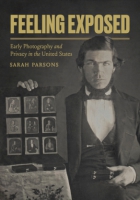



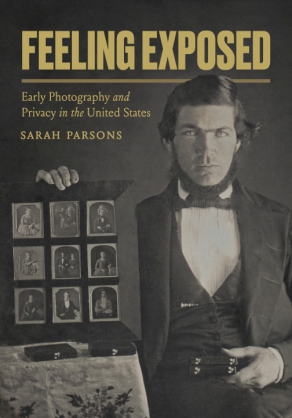
Feeling Exposed
Early Photography and Privacy in the United States
Sarah Parsons
Feeling Exposed
Early Photography and Privacy in the United States
Sarah Parsons
“Fear and fascination accompany most technological developments in near equal measure, and such has certainly been the case for photography. Sarah Parsons compellingly narrates the rapturous praise and intense concern that greeted the medium’s earliest years, deftly weaving firsthand accounts with thoughtful observation and recent scholarship to tease out the dual meanings of photographic exposure—both the act of making a photograph and the experience of feeling laid bare before the camera’s lens. Immerse yourself in this narrative of the medium’s formative first decades, and you’ll gain insight into both its past and our present.”
- Description
- Reviews
- Bio
- Subjects
Despite the limitations of early photographic technology, images could leave subjects feeling exposed. Even portraits made with a sitter’s knowledge might circulate beyond their control. Fears that the camera could reveal inner truths intensified this unease. Drawing on newspapers, popular magazines, photographic journals, literary works, plays, private letters, and studio records from the 1840s through the 1860s, Sarah Parsons traces the emergence of concerns about photography’s role in public life. These sources highlight the dynamic interplay between the desire for both privacy and visibility as Americans engaged with photography as subjects, viewers, photographers, commissioners, buyers, collectors, curators, and gift-givers.
By bringing this understudied archive into focus, Feeling Exposed reframes photography and privacy not as modern problems or byproducts of technological change but as enduring and foundational aspects of the medium’s history. This volume will be of interest to scholars and students in art history, visual culture, photo studies, American studies, literary studies, history, and privacy studies, as well as readers curious about the cultural stakes of photography’s earliest decades.
“Fear and fascination accompany most technological developments in near equal measure, and such has certainly been the case for photography. Sarah Parsons compellingly narrates the rapturous praise and intense concern that greeted the medium’s earliest years, deftly weaving firsthand accounts with thoughtful observation and recent scholarship to tease out the dual meanings of photographic exposure—both the act of making a photograph and the experience of feeling laid bare before the camera’s lens. Immerse yourself in this narrative of the medium’s formative first decades, and you’ll gain insight into both its past and our present.”
Sarah Parsons is Professor of Visual Art and Art History at York University. She is the author of William Notman: Life and Work, coauthor of Photography in Canada, 1839–1989: An Illustrated History, and editor-in-chief of the journal Photography and Culture.
Also of Interest

Mailing List
Subscribe to our mailing list and be notified about new titles, journals and catalogs.